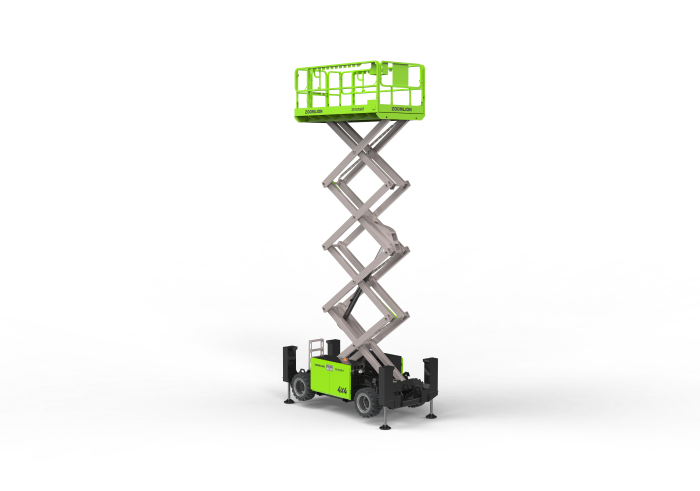
Large construction packages rarely involve one simple task in one controlled area. Projects can include structural work, exterior finishing, mechanical installation, and site services across changing ground conditions. For procurement teams, a rough terrain scissor lift needs to deliver more than working height. It must combine platform capacity, mobility, ground clearance, gradeability, dimensions, and stability with a specification that fits the work plan.
Start With the Actual Work Package
The first step is to translate the construction schedule into equipment requirements. Identify the maximum working height, number of workers, tools and materials to be carried, distance between work zones, and surface conditions along travel routes. A machine that meets the headline height requirement may still be unsuitable if its platform cannot accommodate the planned crew and payload.
Large packages also create a utilization issue. If teams repeatedly reposition an undersized lift, productivity can suffer even when it reaches the work area. Platform dimensions and extension capability matter because they can determine how much work can be completed from one position. Procurement should compare rated capacity and usable deck area with the actual installation sequence.
Terrain Capability Is a Project Requirement
Construction surfaces may include compacted soil, gravel, unfinished slabs, ramps, and areas affected by earthworks. Rough-terrain equipment is designed for outdoor conditions, but the actual site still needs assessment before operation. HSE guidance notes that MEWPs should be used on firm, level ground and warns that trenches, manholes, and uncompacted backfill can contribute to overturning risks.
For large packages, travel performance should be considered alongside platform height. Four-wheel drive, sufficient ground clearance, suitable tires, and useful gradeability can help a lift move between work fronts, but they do not remove the need for ground assessment. Operators should follow manufacturer instructions and site-specific risk controls, especially near edges, slopes, excavations, or changing surfaces.
Capacity Must Cover People, Tools, and Materials
A lift’s platform capacity is not simply a number for comparing catalogues. It should be checked against the complete intended load: personnel, hand tools, components, temporary materials, and anything else carried onto the platform. Extension decks require separate attention because their rated capacity can differ from the main platform.
This becomes important on large construction packages, where crews may consolidate tasks to reduce travel and repositioning. Consolidating loads can improve workflow only when the machine remains within its rated limits. Procurement teams should also review how capacity changes at different configurations and ensure operators have access to relevant operating information before the machine reaches the site.
Mobility Can Affect Overall Site Productivity
A large project may have several active fronts operating simultaneously. Moving a lift efficiently between those areas can reduce non-working time, particularly where temporary roads or unfinished ground are involved. Stowed travel speed, turning radius, wheelbase, machine width, and transport weight can therefore influence whether the selected unit fits the project’s logistics plan.
The right choice is not necessarily the largest lift available. A machine that is difficult to transport, maneuver, or position can create bottlenecks. Procurement should map the lift’s intended route from delivery point to work zones and confirm that access gates, ramps, haul roads, and working areas can accommodate the machine safely.
Check the ZS1018RT Specification Against the Job Plan
The Zoomlion Access ZS1018RT is a diesel rough-terrain model designed around outdoor lifting requirements. Its official specification lists a 12 m maximum working height and 500 kg platform capacity. It also has a 1.5 m platform extension, 0.24 m ground clearance, four-wheel drive, solid tires, and 40% gradeability (22°). The listed gross weight is 4,600/4,000 kg.
For a large construction package, these specifications provide concrete checkpoints. The 500 kg platform capacity should be compared with the planned crew and materials, while the 1.5 m extension can support work over a broader area from a positioned machine. The 4WD system, ground clearance, and stated gradeability are relevant when project logistics involve outdoor and unfinished surfaces.
Use the Zoomlion scissor lift manual During Selection
Specifications are only one part of equipment planning. Buyers should also review the Zoomlion scissor lift manual and related operating documentation before deployment. The manual should be treated as an operational reference for machine limitations, controls, inspection requirements, safe use conditions, and maintenance procedures rather than paperwork completed after purchasing.
For the ZS1018RT, procurement teams can use the Zoomlion scissor lift manual alongside the product specification to align fleet planning with operator training and site procedures. Checking documentation early can also reveal requirements affecting transportation, pre-start inspections, servicing, or operating conditions. The manual for the supplied configuration should be confirmed with the manufacturer or authorized support channel.
Why Consider Zoomlion Access for Large Packages?
Zoomlion Access states that its portfolio covers more than 100 MEWPs across five categories, including scissor lifts, telescopic boom lifts, articulating boom lifts, spider lifts, and telehandlers. Its company information also identifies rental companies, contractors, and other professional users across international markets as part of its customer base.
For buyers managing a large construction package, that broader range can matter when multiple access requirements emerge across project phases. The key is to match each machine to documented height, capacity, terrain, access, transport, and compliance requirements. Zoomlion Access can then be evaluated on how its equipment specifications and technical support align with those defined project needs.
