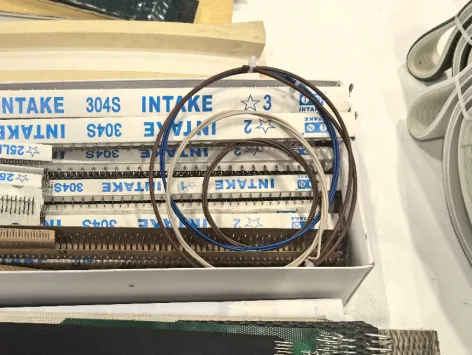
Mechanical belt fasteners depend on a central pivot axis to transfer tension while preserving flexibility. Carded wire systems secure individual hooks into the belt carcass, creating parallel loops that protrude past the belt end. Inserting a dedicated conveyor belt hinge pin locks these alternating loops together, establishing a high-strength articulating joint.
Conveyor belts navigate driving pulleys, snub rollers, and troughing idlers while sustaining high mechanical strain. Without a compliant hinge element, rigid joints crack carcass plies and peel away from terminal ends. Proper hinge mechanics convert continuous pulling forces into uniform radial articulation without sacrificing operational uptime.
Interlocking Loop Geometry and Pivot Mechanics
Carded hook strips guarantee precise, uniform spacing across the entire belt edge. Individual wire hooks sit embedded in rigid paper cards, preventing skew during installation comb insertion. Clinching these hooks alternately from both belt ends yields intermeshing loops that form a single cylindrical channel.
Inserting the pin through this channel creates an interlocking knuckle assembly similar to a piano hinge. Rotational freedom within the loops allows the belt joint to bend naturally over crowned pulleys. Diameter tolerances between the loop interior and pin exterior remain critical, as excessive clearance causes joint elongation under tension.
Snug pin fitment prevents destructive micro-chattering against the inner hook crown during high-speed travel. Tight mechanical alignment ensures each wire hook bears an equal fraction of the continuous belt load. Even microscopic discrepancies in loop pitch accelerate premature fatigue along individual hook legs.
Tensile Load Transfer and Shear Stress Dissipation
Longitudinal tension pulling against the belt carcass translates directly into shearing forces against the pin shaft. Wire hook legs transmit tensile loads from carcass cords into the curved loop crowns surrounding the pin. The pin acts as a continuous beam subjected to multi-point shear loads in opposing directions.
Direct collaboration with an established hinge pin manufacturer ensures the pin steel possesses sufficient yield strength to resist bending between adjacent loops. Deflection along the pin axis concentrates stresses on outer belt edges, triggering progressive hook pullout. High shear resistance maintains straight belt tracking across return idlers.
Engineering teams at Intake design carded hook profiles to optimize contact surface area between wire loops and the pin body. Maximizing this footprint reduces localized compressive stresses that deform softer metal alloys. Balanced force distribution prevents individual loops from binding during troughing transitions.
Core Metallurgies and Jacket Dampening Under Dynamic Flexing
Solid spring wire pins provide exceptional rigidity and shear strength for flat conveyor configurations. Package handling systems with wide pulleys benefit from the structural stability of hardened carbon or stainless wire cores. Rigid pins maintain an unyielding joint axis that resists crushing from external impact forces.
Troughed conveyors require greater lateral flexibility to conform to angled idler sets without popping center fasteners. Stranded aircraft cable cores deliver superior multi-plane flexibility, allowing the conveyor belt hinge pin to curve smoothly across three-roll idler transitions. Braided internal strands absorb torsional twisting without taking a permanent mechanical set.
Extruded nylon coatings surrounding stranded wire cables cushion contact between steel hook crowns and the internal core. Polymeric jacketing dampens operational vibration, attenuates running noise, and seals internal cable strands from moisture ingress. Smooth outer polymer skins also facilitate easier pin insertion through long mechanical splices.
Manufacturing protocols developed by Intake utilize abrasion-resistant polymer coatings calibrated to endure continuous cyclic pressure. Specialized protective sleeves shield the core metal from corrosive process chemicals and washdown fluids. Resilient jackets isolate dissimilar metals, preventing galvanic corrosion between stainless hooks and carbon cable cores.
Loop Notching Dynamics and Joint Migration Prevention
Continuous reciprocal movement between hard wire loops and the softer pin body inevitably creates abrasive wear. Airborne grit, sand, and dust settle into hinge loop cavities, acting as dynamic grinding media against the pin shaft. Unchecked abrasion creates deep transverse grooves, commonly known as notching, across the pin circumference.
Notched pins lock wire loops into fixed grooves, destroying the joint’s rotational freedom. Rigid, locked loops experience intense bending fatigue around pulleys, fracturing hook legs at the belt edge. Sourcing from a reputable hinge pin manufacturer guarantees case-hardened coatings and wear-resistant jackets engineered to resist progressive surface notching.
Lateral pin migration represents another critical operational hazard that compromises splice stability. Vibrational harmonics and side-loading forces cause unsecured pins to work their way out of the lacing channel. Exposed belt ends separate instantly upon losing pin engagement, leading to catastrophic longitudinal rips.
Retaining washers, crimped end collars, or bent locking tails secure the conveyor belt hinge pin firmly inside the joint channel. Maintenance technicians can quickly inspect these mechanical retaining points during routine walk-around evaluations. Reliable locking mechanisms keep the pin centered across the full operating belt width.
Operational Synergy Across the Mechanical Splice
Successful conveyor operation relies on treating the pin and carded fastener assembly as a unified mechanical system. Mismatched components accelerate joint wear, degrade tracking, and cause unplanned operational shutdowns. Precision matching between loop curvature and pin diameter maximizes joint service life under demanding industrial conditions.
Standardized production lines at Intake deliver tightly tolerance-matched carded fasteners alongside corresponding hinge pins to optimize splice synergy. Rigorous testing protocols verify that hook clinch geometry mates seamlessly with specified pin diameters. Complete component alignment eliminates guessing from routine plant maintenance procedures.
Consulting a seasoned hinge pin manufacturer allows maintenance supervisors to tailor pin selection to specific pulley diameters, chemical environments, and belt speeds. Replacing worn pins during scheduled maintenance windows restores joint integrity without requiring complete belt resplicing. Proper pin mechanics ultimately preserve conveyor assets and ensure uninterrupted plant productivity.
