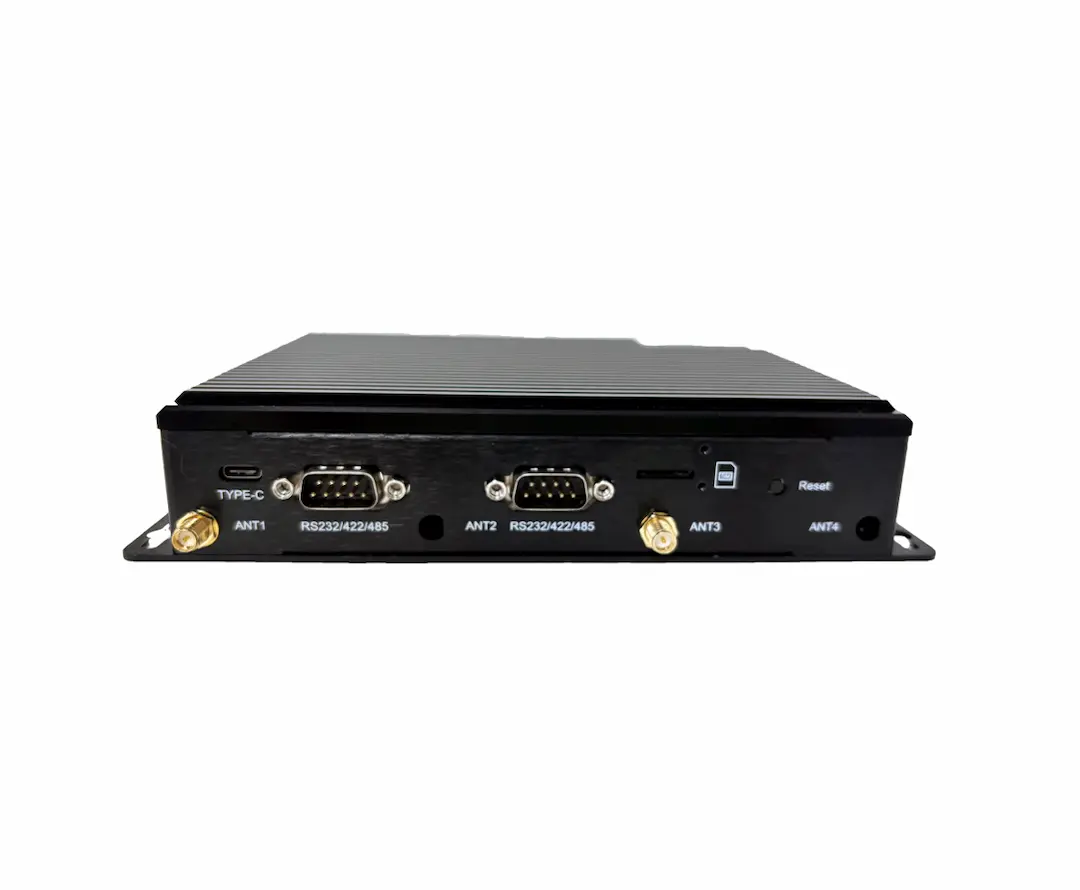
A production cell can run smoothly until dust, vibration, or a failed cooling fan turns a line-side controller into a maintenance task. Vantron’s embedded industrial computer category includes compact fanless controllers and GPU-accelerated AI computers for machine control, vision inspection, robotics, and edge processing. A Fanless embedded PC can reduce moving parts, but it still requires careful thermal and software validation.
Fanless cooling is only one part of the selection. You also need to evaluate the enclosure, operating system, peripheral interfaces, workload pattern, remote service process, and expected product life. A smart-factory computer may control a packaging cell, collect sensor data, run local inference, and drive an HMI at the same time.
What Does Fanless Cooling Change?
A fanless computer removes the moving fan used to force air across a heatsink. Heat instead travels through a heat spreader, chassis, or other conduction path before leaving the enclosure. That can reduce dust movement, fan wear, acoustic noise, and one source of mechanical failure near a production line.
Consider a controller mounted beside a food-packaging machine. Fine particles may collect around equipment, while vibration continues through every shift. Fewer moving parts can simplify maintenance, but fanless construction does not make heat disappear. The enclosure still needs enough surface area and a suitable mounting arrangement to release heat.
Environmental protection also needs precise interpretation. An IP65 front bezel, for example, does not make the entire computer washdown-rated. The rear housing, cable glands, connectors, and mounting points still need review. For a line exposed to cleaning chemicals or spray, assess the complete installation rather than relying on the front-panel rating.
Thermal Capacity Depends on the Workload
A fanless embedded computer may handle a light control task with less heat than a system running continuous vision inference. CPU utilization, GPU activity, storage access, display output, and network traffic all contribute to the thermal load. A short benchmark can miss heat accumulation during a long production cycle.
The category’s industrial computers are described as supporting continuous 24/7 processing and wide operating-temperature use. Those characteristics are useful starting points, not substitutes for application testing. Mount the computer as it will be installed, run the expected software, and observe behavior during the longest representative workload.
Edge AI can change the thermal profile quickly. A GPU-accelerated computer processing camera feeds may spend much of its time on inference rather than ordinary control logic. If a factory controller also manages PLC communication, operator graphics, and data logging, test the combined workload instead of qualifying the AI model in isolation.
A fanless design stays within its thermal envelope only under suitable workload, ambient, mounting, and enclosure conditions. If the system repeatedly approaches its limit, a larger enclosure, lower-power processor, reduced workload, or actively cooled design may be more appropriate.
How Does Industrial Computer Automation Handle Factory Data?
For industrial computer automation, the computer sits between physical equipment and software services. It may receive sensor values, coordinate machine states, collect camera images, send commands to a PLC, and present alarms on an HMI. Each function creates a different demand for timing, connectivity, storage, and recovery.
Start with the data path. A camera inspection station may need predictable image capture, while a motor controller depends on timely command delivery. A warehouse robot may require sensor processing and safety-related I/O. A line-side gateway may prioritize protocol conversion and secure transfer to a supervisory system.
The product category describes rich connectivity and peripheral support, but your design review should still map every required connection. Record camera links, display outputs, serial channels, Ethernet networks, CAN buses, digital I/O, storage, and service ports. Then check whether the selected configuration supports them simultaneously without relying on untested adapters.
Mechanical placement matters as well. A controller inside a sealed cabinet may have less effective heat dissipation than the same unit mounted in open air. Cable routing can affect service access, while a nearby motor drive may introduce electrical noise. Validate the computer in its actual cabinet and wiring arrangement.
Software and Edge AI Need a Shared Validation Plan
The category supports Android, Linux, and Windows, with SDKs for device-level integration. That range can help you align the operating system with existing machine-control software, camera drivers, operator applications, and remote-service tools. The practical question is not simply which OS is available, but which software image your team can maintain over the deployment period.
For local machine vision, an accelerator can process supported neural-network operations while the CPU handles image movement, preprocessing, control logic, and reporting. NXP i.MX8 / i.MX9, Qualcomm, MediaTek Genio, and Intel are platform families that engineers may evaluate for different embedded workloads. The selected runtime, driver support, and model format matter as much as the processor family.
A model that runs well in a development environment may behave differently after deployment. Unsupported layers can fall back to the CPU. Camera drivers can affect frame timing. Updates can change memory use or accelerator behavior. Test the complete pipeline, including image capture, preprocessing, inference, postprocessing, display output, PLC response, and restart recovery.
Remote management also belongs in the design. A factory computer needs controlled updates, useful logs, configuration backup, and a recovery path after a failed software change. Local inference can reduce the need to transmit raw images, but it does not remove the need to monitor device health and retain operational records.
Choose the Computer Around the Factory Cell
Choose a fanless system when the workload fits its thermal envelope, the enclosure can dissipate heat, and reducing moving parts has clear maintenance value. This often suits a line-side controller, HMI backend, protocol gateway, or focused inspection node with a stable software workload.
Choose a different thermal design when continuous GPU processing, high peripheral activity, restricted cabinet airflow, or elevated ambient conditions leave little margin. A fanless computer is not automatically the right choice for every AI workstation or multi-camera inspection system.
Before freezing the design, run a site-based review covering workload, cabinet temperature, mounting, cable access, I/O concurrency, software updates, and recovery time. The supplier has worked in embedded computing for more than 20 years, with over 200 research personnel from a variety of fields supporting product development and lifecycle planning.
For projects requiring a tailored OS, interfaces, I/O, enclosure, or logo, Vantron provides OEM/ODM customization and FAE support. Treat those services as part of the integration plan, alongside thermal testing and a complete factory-cell validation.
